

Pricing Pressure Washing by the Square Foot: A Formula That Actually Protects Your Margins
Pricing commercial pressure washing by the square foot can make proposals faster and easier to compare. It can also destroy your margins if you treat square footage as the entire estimate.
A profitable per-square-foot rate starts with one question:
How much does it cost your company to clean one square foot under the actual conditions of this job?
The answer depends on production rate, labor burden, water and chemical usage, equipment overhead, travel, setup, site difficulty, contingency, and profit margin. Build those inputs correctly, and your rate becomes a defensible business tool instead of a guess.
This guide shows you how to price large commercial, municipal, HOA, university, and property-management projects while protecting profitability.
Protect Your Margins by Calculating True Cost Per Square Foot
Your selling price must cover every cost required to complete the work. Start with your break-even cost before adding profit.
Use this foundation:
True cost per square foot =
Labor + water + chemicals + equipment + overhead + travel/setup + site adjustments
÷ Total square feet
Your cost categories should include:
- Fully burdened labor
- Fuel and transportation
- Water usage or water hauling
- Detergents, degreasers, and specialty chemicals
- Equipment depreciation or lease payments
- Repairs, maintenance, and replacement reserves
- Insurance, licensing, administration, and shop expenses
- Setup, teardown, protection, and cleanup
- Traffic control, water recovery, lifts, or other required services
- A reasonable contingency for known uncertainty
Do not price from the cost of labor alone. A bid can look profitable on paper while quietly losing money through travel, equipment wear, idle time, and extended setup.
Increase Profit by Measuring Real Production Rates
Production rate drives your per-square-foot economics more than almost any other variable.
Calculate your production rate in square feet per productive hour:
Production rate =
Square feet cleaned ÷ Active cleaning hours
Then calculate labor cost per square foot:
Labor cost per square foot =
Fully burdened crew cost per hour ÷ Production rate
Your fully burdened crew cost includes:
- Wages
- Payroll taxes
- Workers’ compensation
- Benefits
- Paid training
- Required supervisory time
For example, a two-person crew with a fully burdened cost of $64 per hour that produces 6,000 square feet per hour carries a direct labor cost of approximately $0.011 per square foot.
That number changes quickly when site conditions slow the crew. Tight access, parked vehicles, heavy grease, frequent hose moves, and drainage restrictions reduce production. Use production data from similar jobs instead of relying on an optimistic best-case rate.
Track these numbers after every major project:
- Estimated production rate
- Actual production rate
- Estimated crew hours
- Actual crew hours
- Setup and teardown time
- Rework or return visits
Your own field data gives you a more reliable pricing advantage than generic online averages. Current commercial pricing guides, including Housecall Pro’s pressure washing pricing overview, can provide market context, but your internal cost structure determines your minimum profitable rate.
Reduce Labor Cost Without Underbidding the Job
Faster equipment should improve your margin, not force you to charge less.
If a high-volume system allows you to complete the same scope in fewer labor hours, your cost decreases while the customer still receives the agreed result. That creates room for stronger profit, additional capacity, or a more competitive bid without sacrificing financial discipline.
Hi-Low Solutions builds equipment around high water volume and complete system performance. Its 17 GPM pressure washer is designed for large commercial and industrial cleaning tasks, while custom systems can combine machines for substantially higher flow.

The business case is straightforward:
- More water volume can improve coverage and rinsing efficiency.
- Higher production can reduce crew hours.
- Fewer crew hours can lower direct labor cost.
- Shorter project duration can free capacity for another contract.
- Better capacity can support business growth without immediately adding another full crew.
Hi-Low reports that one company cleaned 65,000 square feet of parking garages in a day with one employee, while another completed a 600,000-square-foot parking garage in three days. These results are examples, not universal production guarantees. Your estimate must reflect your equipment, crew, surface, soil load, water access, and operating procedures.
The correct approach is to keep your target price tied to value and required profit, not to pass every efficiency gain back to the customer.
Control Water and Chemical Costs Per Square Foot
Water often costs less than labor, but commercial jobs can use thousands of gallons. Include it in your estimate.
Calculate water cost this way:
Water cost =
Gallons used × Local water cost per gallon
Estimate gallons from actual flow and pump time:
Gallons used =
GPM × Active pump hours × 60
For a 17 GPM machine operating for 17 active hours, the theoretical usage is approximately 17,340 gallons. Actual use may vary because of trigger time, pauses, filling, recovery requirements, and rinse procedures.
Include additional water-related costs when applicable:
- Water hauling
- Tank filling
- Metered-site charges
- Water recovery
- Filtration or disposal
- Environmental compliance
Chemical cost requires the same discipline. Track product usage by test area or by 1,000 square feet.
Chemical cost per square foot =
Total chemical cost for test area ÷ Test area square footage
Your chemical estimate should account for:
- Product price per gallon
- Dilution ratio
- Application rate
- Dwell time
- Reapplication
- Neutralizing agents
- Waste and overspray
Heavy grease, oil, gum, rust, algae, and paver sealer stripping require separate allowances. Do not hide specialty treatments inside a low base rate.
Recover Equipment Investment Through Every Job
Equipment produces revenue only when you recover its cost through billable work.
Build an equipment cost per hour using:
Equipment cost per hour =
Annual equipment allocation ÷ Annual billable equipment hours
Your annual allocation may include:
- Depreciation or financing
- Routine maintenance
- Repairs
- Pump and engine service
- Hoses, nozzles, swivels, and wear parts
- Insurance
- Replacement reserves
Add fuel separately if it is not already included in the equipment rate. Avoid double counting.
Then convert equipment cost to a square-foot rate:
Equipment cost per square foot =
Equipment cost per hour ÷ Production rate
High-volume systems require capital, but they can also change the cost structure of a job. A system that cuts project hours may reduce labor, fuel, and nonbillable supervision. The important measurement is not the purchase price alone. It is the equipment’s contribution to profit per productive hour.
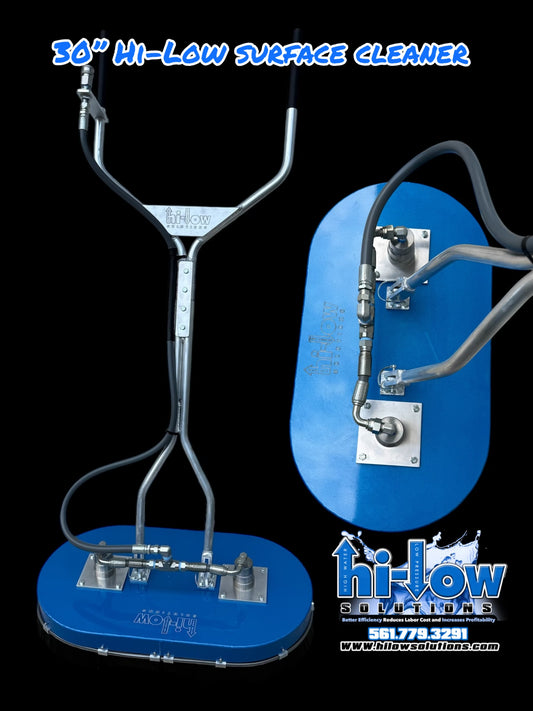
Review Hi-Low’s surface cleaner collection to compare equipment designed for different production requirements, including 20-inch, 26-inch, 30-inch, and 36-inch options.
Charge for Travel, Setup, and Operational Disruption
A 100,000-square-foot site does not automatically mean 100,000 square feet of continuous cleaning.
Commercial work often includes:
- Site walks and pre-job coordination
- Loading and unloading
- Long hose deployment
- Water and power setup
- Signage and traffic control
- Protection of doors, walls, landscaping, and equipment
- Drainage planning
- Cleanup and equipment breakdown
- Working around tenants, vehicles, or pedestrians
Estimate the total crew time, not just the time the surface cleaner spends moving.
Travel/setup cost =
Crew hourly cost × Travel, setup, teardown, and cleanup hours
For smaller or distant projects, use a minimum mobilization charge. For large sites, include travel and setup as a separate line item so the client can see exactly what the bid covers.
Adjust the Rate for Difficult Site Conditions
Square footage does not measure risk or complexity. Separate difficult conditions from your base cleaning rate.
Common adjustments include:
- Heavy oil or grease
- Gum removal
- Deep organic growth
- Rust or efflorescence treatment
- Paver sealer stripping
- Tight access or frequent obstacles
- Multi-level structures
- Night or weekend work
- Limited water access
- Water recovery requirements
- Lift or specialty equipment
- Traffic control
- Sensitive surfaces or restricted chemical use
For curb and gutter work, a dedicated tool can change the labor calculation. Hi-Low’s CURBINATOR on Wheels is designed to clean the top and face of D curbs, or the top, face, and gutter of H curbs, in a mobile setup. It requires at least 16–21 GPM and 3,000 PSI or higher for optimal performance.
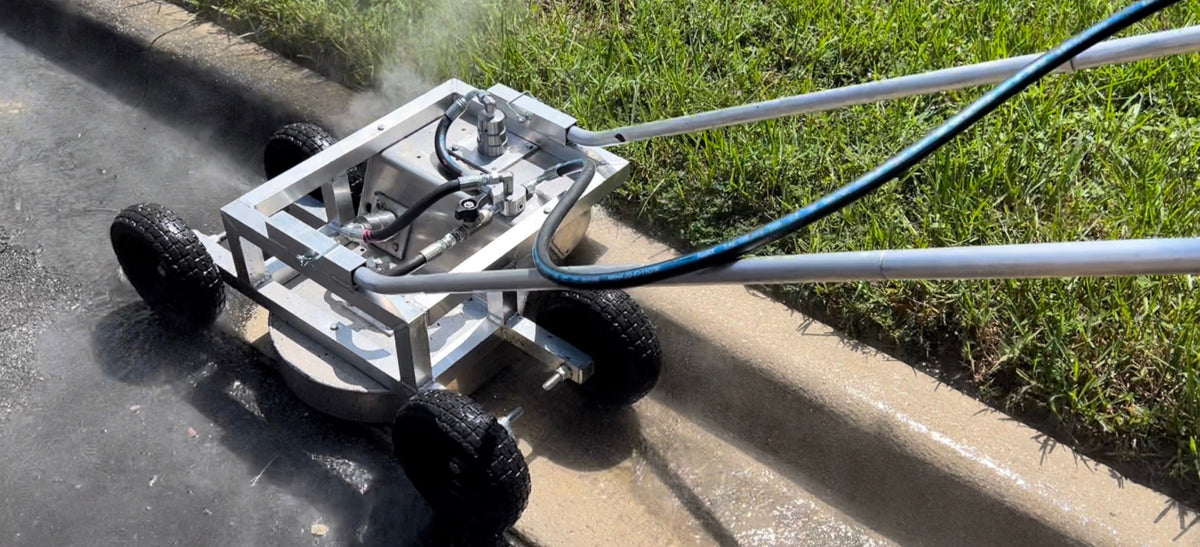
Hi-Low also shares a customer account describing nearly two miles of street gutters cleaned with one operator using the CURBINATOR, compared with three workers cleaning one-quarter mile by hand the previous day. That type of production improvement does not eliminate the need for careful estimating. It gives you better information about the labor required.
Use Contingency to Manage Uncertainty
A contingency protects the estimate from conditions you cannot fully verify before work begins. It should not replace a site inspection or become an unexplained markup.
Apply contingency to the uncertain portion of the job, such as:
- Unverified square footage
- Unknown soil depth
- Incomplete water-access information
- Potential extra setup
- Possible reapplication
- Unclear drainage or recovery requirements
For a well-documented project, a modest allowance may be appropriate. For a poorly documented site, use explicit assumptions, exclusions, and change-order terms instead of burying excessive risk inside the square-foot rate.
Add Profit Using Margin, Not Guesswork
After calculating total cost, apply your target profit margin.
Selling price =
Total cost ÷ (1 − Target profit margin)
A 30% margin is not the same as a 30% markup. If your total cost is $0.09 per square foot:
$0.09 ÷ (1 − 0.30) = $0.1286 per square foot
Your selling rate would be approximately $0.13 per square foot.
This formula ensures profit represents 30% of revenue. A simple 30% cost markup would produce a lower margin and could leave your company short of its target.
Example: Build a Defensible Commercial Bid
Assume a 100,000-square-foot parking area with moderate soil and straightforward access:
- Production rate: 6,000 square feet per active hour
- Total crew time, including setup and cleanup: 20 hours
- Fully burdened labor: $64 per crew hour
- Labor: $1,280
- Water: $260
- Chemicals: $420
- Equipment and fuel: $1,100
- Allocated overhead: $700
- Site difficulty allowance: $650
- Subtotal: $4,410
- Contingency at 10%: $441
- Total estimated cost: $4,851
With a 30% target margin:
$4,851 ÷ 0.70 = $6,930
Your bid would be approximately $6,930, or about $0.069 per square foot.
Present the proposal as a complete scope, not merely a low number:
- Areas included and excluded
- Measured square footage
- Cleaning method
- Expected production schedule
- Labor and equipment plan
- Chemical or specialty treatment allowances
- Water and recovery responsibilities
- Traffic-control requirements
- Assumptions and exclusions
- Change-order conditions
- Total project price
For municipalities, universities, HOAs, and property managers, this structure creates a professional record. It helps the buyer compare proposals based on scope, safety, turnaround time, and accountability instead of price alone.
Build a Pricing System That Scales
Review completed jobs monthly. Compare estimated performance with actual results and update your production database.
Watch:
- Revenue per crew hour
- Actual square feet per hour
- Chemical cost variance
- Equipment downtime
- Travel and setup time
- Rework percentage
- Profit margin by job type
The strongest contractors work smarter, not harder. They use cutting-edge equipment, accurate production data, and disciplined pricing to increase output without underbidding their value.
Hi-Low Solutions’ philosophy is simple: better efficiency reduces labor and increases profitability. If you are evaluating a high-volume rig or surface-cleaning system for your operation, explore the BEAST Cleaning System, review the case studies, or schedule a discovery call to discuss your production goals.
A defensible bid starts with accurate costs. A stronger operation starts with a system that improves the economics behind every square foot.